AI API Token Price Comparison 2026: GPT-5.6, Claude Fable 5.1, Gemini 3.6, DeepSeek & More
A practical breakdown of input and output token prices per 1M tokens across the leading AI providers in 2026, with guidance on choosing the right model for your budget and use case.
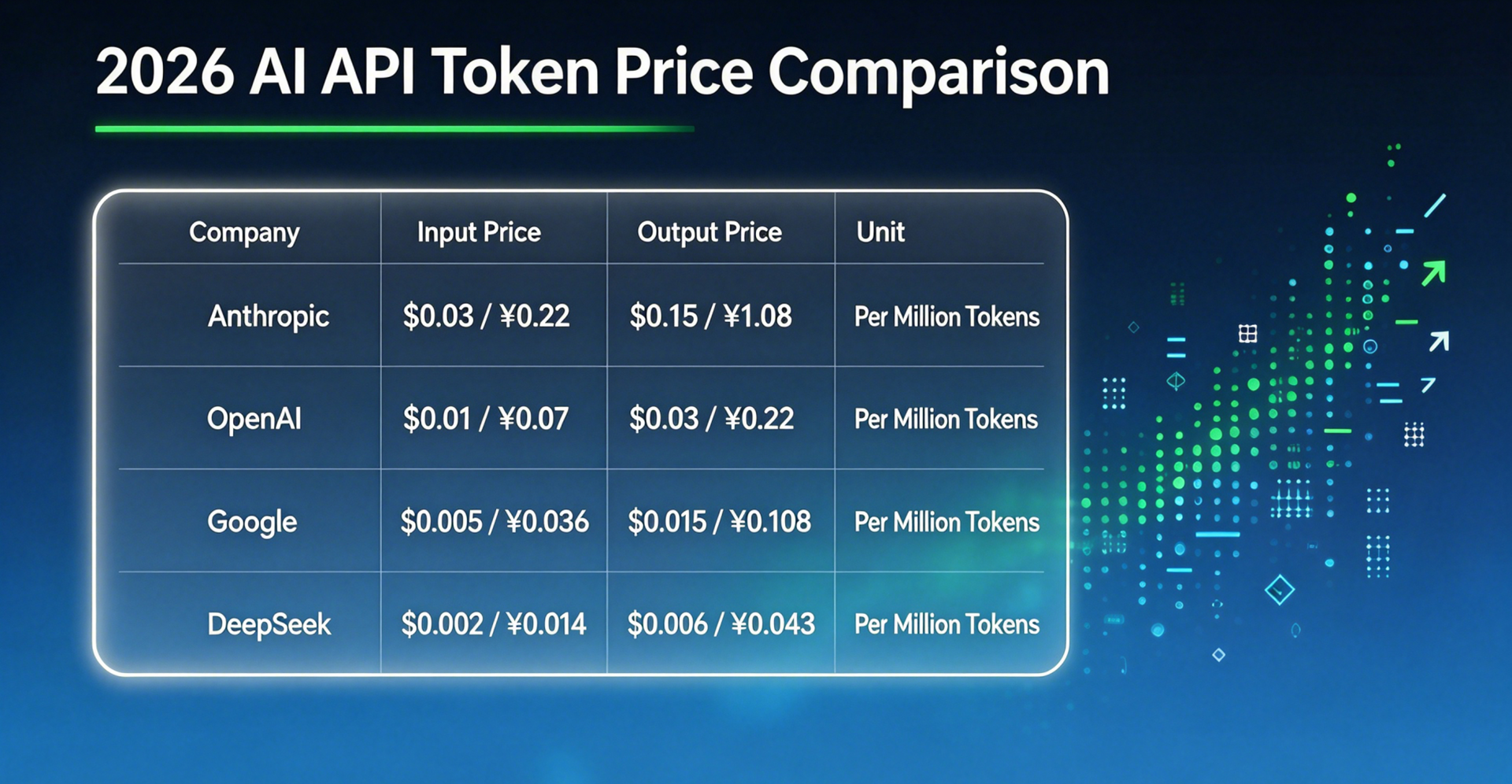
1) 2026 Token price comparison table
The table below lists standard API prices per 1 million tokens as verified on September 3, 2026. International providers price in USD; Chinese providers price in CNY. Prices reflect standard non-batch, non-cached API calls. Batch and prompt caching can reduce costs, while DeepSeek also splits rates into peak and idle windows.
Note: prices change frequently. Always verify on the provider's official pricing page before making budget decisions. If you're looking to minimize costs, our free AI API guide covers which providers offer free tiers that can supplement your paid usage.
- Claude Fable 5.1 (Anthropic): Input $10.00 / Output $50.00 per 1M tokens — highest public Claude tier
- GPT-5.6 Sol (OpenAI): Input $5.00 / Output $30.00 per 1M tokens — flagship reasoning
- GPT-5.6 Terra (OpenAI): Input $2.00 / Output $12.00 per 1M tokens — balanced performance
- Gemini 3.6 Flash (Google): Input $1.50 / Output $7.50 per 1M tokens — latest stable balance
- GPT-5.6 Luna (OpenAI): Input $0.20 / Output $1.20 per 1M tokens — cost-efficient OpenAI
- Gemini 3.5 Flash-Lite (Google): Input $0.30 / Output $2.50 per 1M tokens — stable high-throughput value
- DeepSeek V4 Flash: cache-miss input ¥1.5 idle / ¥3.0 peak · output ¥4.5 idle / ¥9.0 peak per 1M tokens — cache-hit ¥0.05 / ¥0.10
- DeepSeek V4 Pro: cache-miss input ¥4.5 idle / ¥9.0 peak · output ¥13.5 idle / ¥27.0 peak per 1M tokens — cache-hit ¥0.15 / ¥0.30
- Kimi K3 (Moonshot): Input ¥20.00 / Output ¥100.00 per 1M tokens
- GLM-5.2 (ZhipuAI): Input ¥8.00 / Output ¥28.00 per 1M tokens
2) Why do token prices vary so much?
Model capability is one pricing factor. More demanding reasoning and agent workloads can use more compute per token. At current list prices, Claude Fable 5.1 output costs 20 times as much per token as Gemini 3.5 Flash-Lite output.
Compute infrastructure matters too. Companies like Google own custom TPUs and large-scale data centers, which reduces their marginal cost per token. OpenAI and Anthropic rely more on third-party GPU clusters, which affects their floor pricing.
Market positioning is a deliberate choice. Anthropic targets enterprise customers who prioritize safety, accuracy, and long context. OpenAI spans the full market from consumer to enterprise. Chinese providers like DeepSeek compete aggressively on price to build market share in the domestic developer ecosystem.
Architecture differences — such as Mixture of Experts (MoE) versus dense transformers — also affect costs. MoE models activate only a subset of parameters per token, reducing compute. DeepSeek uses MoE which contributes to its low pricing.
3) Watch out: output tokens cost more than input
For every model in this comparison, output tokens are 3–6x more expensive than input tokens. This matters a lot in practice: a task that generates 2,000 output tokens costs far more than a task that reads 2,000 input tokens.
Use cases like summarization, classification, and extraction are input-heavy and cheaper. Long-form content generation, code synthesis, and multi-step reasoning are output-heavy and expensive. When estimating costs, always model your expected output length, not just your prompt length.
Thinking or reasoning modes (like extended thinking in Claude or o-series in OpenAI) can generate very large output token counts through internal chain-of-thought. These modes are powerful but multiply your output costs — enable them only when accuracy gains justify the expense.
4) Which model should you use?
There is no single right answer — the best model depends on your task, quality requirements, volume, and budget. For broader context on AI model fundamentals, the beginner's guide to AI is a great starting point. Here is a practical breakdown by use case.
For difficult long-horizon agents and codebase work, Claude Fable 5.1 and GPT-5.6 Sol are premium candidates. High-stakes legal or medical output still requires qualified human review; a higher model price does not make the result automatically reliable.
For general-purpose application backends — customer support, document processing, RAG pipelines — GPT-5.6 Terra, Gemini 3.6 Flash, or GPT-5.6 Luna hit a strong capability-to-cost ratio. These models handle most real-world tasks well at a fraction of flagship cost.
For high-volume, latency-sensitive workloads — content moderation, classification, lightweight summarization — Gemini 3.5 Flash-Lite at $0.30/$2.50 is Google’s current stable low-cost option. DeepSeek V4 Flash is the lower-cost V4 choice for Chinese-language workloads: peak cache-miss input / output is ¥3.0 / ¥9.0 per 1M tokens, idle is half, and cache-hit input is ¥0.05 idle / ¥0.10 peak.
For Chinese-language applications with domestic infrastructure needs — RMB billing, low latency in China, local compliance — DeepSeek, Kimi K3, and GLM-5.2 are the practical choices. DeepSeek leads on price; Kimi K3 leads on reasoning and long context. Regardless of which provider you choose, you'll need an API key to start making calls.
5) Practical ways to reduce your API costs
Batch inference cuts costs by 50% on most providers. If your tasks do not require real-time responses — offline document processing, nightly data enrichment, bulk classification — always use the batch API. The tradeoff is latency (results return within hours, not seconds). Using an aggregator like OpenRouter can also simplify billing across multiple providers.
Prompt caching reduces repeated input costs. If your prompts share a long system prompt or large context document, providers like Anthropic and OpenAI cache the prefix and charge a fraction of the normal input price for cache hits. This is particularly effective for RAG and agent systems.
Model routing saves money at scale. Use a cheap model (Gemini Flash-Lite, GPT-5.6 Luna) for simple sub-tasks and a premium model only when complexity demands it. Many production systems route 80% of queries to cheap models and 20% to expensive ones, cutting average cost by 60–70%.
Trim your prompts. Verbose system prompts, unnecessary examples, and repeated context all add input tokens. A 30% reduction in average prompt length means a 30% reduction in input costs. Use structured output (JSON mode) to minimize output verbosity.
For DeepSeek specifically, shift batch and evaluation traffic into idle hours (outside Beijing time 09:00–12:00 and 14:00–18:00) to pay half the peak rate, and keep reusable prefixes stable so cache-hit input stays at ¥0.05–¥0.30 per 1M tokens.
- Use batch APIs for non-real-time tasks (50% discount on most providers)
- Enable prompt caching for long, repeated system prompts
- Route cheap tasks to cheap models — only route complex tasks to premium models
- Trim system prompts and avoid repeating context that is already in the model's window
- Use JSON output mode to avoid verbose natural-language wrapping in responses
- On DeepSeek, run batch jobs in idle hours (outside Beijing 09:00–12:00 and 14:00–18:00) to pay half the peak rate
6) Comparing domestic and international pricing
Direct price comparison between USD and CNY models requires a current currency conversion. After the August 2026 update, DeepSeek V4 Flash peak cache-miss input/output is ¥3.0/¥9.0 per 1M tokens, while V4 Pro is ¥9.0/¥27.0. Idle hours are half of peak. Compare them with international providers only after converting currency and adding payment, networking, and deployment costs.
However, international models are generally inaccessible directly from mainland China without a proxy. For teams operating in China, the real comparison is between domestic options: DeepSeek (lowest price), GLM-5.2 (mid-range), and Kimi K3 (premium reasoning). Each also includes domestic billing, support in Chinese, and compliance with domestic data regulations.
For teams with a global user base, international models are the default choice. The key question is whether to use a single premium model or mix tiers based on query complexity.
FAQ
Are these prices for input or output tokens?
Both. Input and output tokens are priced separately, and output tokens are typically 3–6x more expensive than input tokens. The price table in section 1 lists both for each model.
Does using a cheaper model always save money?
Not always. Cheaper models may produce lower quality outputs that require retries, human correction, or longer prompts to compensate. Calculate total cost including error rates, prompt length needed, and downstream correction effort — not just token price.
How often do AI API prices change?
Frequently. Most providers have reduced prices multiple times in 2025–2026 as infrastructure costs fall. Always check the provider's official pricing page for current rates before budgeting.
What is the cheapest model for high-volume workloads?
For Google workloads, Gemini 3.5 Flash-Lite at $0.30/$2.50 per 1M tokens is the lowest-cost stable Gemini model highlighted here. For domestic Chinese workloads, DeepSeek V4 Flash peak cache-miss input/output is ¥3.0/¥9.0 per 1M tokens; idle is half, and cache-hit input is ¥0.05/¥0.10. Recheck the official page before budgeting.
Do context window size and reasoning modes affect price?
Yes. Longer context means more input tokens per request. Reasoning/thinking modes generate large hidden output token counts for chain-of-thought, which is billed at the standard output rate. Both significantly increase per-request cost compared to short, non-reasoning prompts.
Related in This Series
Sources
- Anthropic Fable 5.1 and API PricingAnthropic · Checked 2026-09-03
- OpenAI API PricingOpenAI · Checked 2026-07-25
- Google Gemini API PricingGoogle AI · Checked 2026-08-10
- DeepSeek API PricingDeepSeek · Checked 2026-08-21
- Moonshot (Kimi) PricingMoonshot · Checked 2026-07-25
- ZhipuAI GLM PricingZhipuAI · Checked 2026-07-25